 @social-bridge
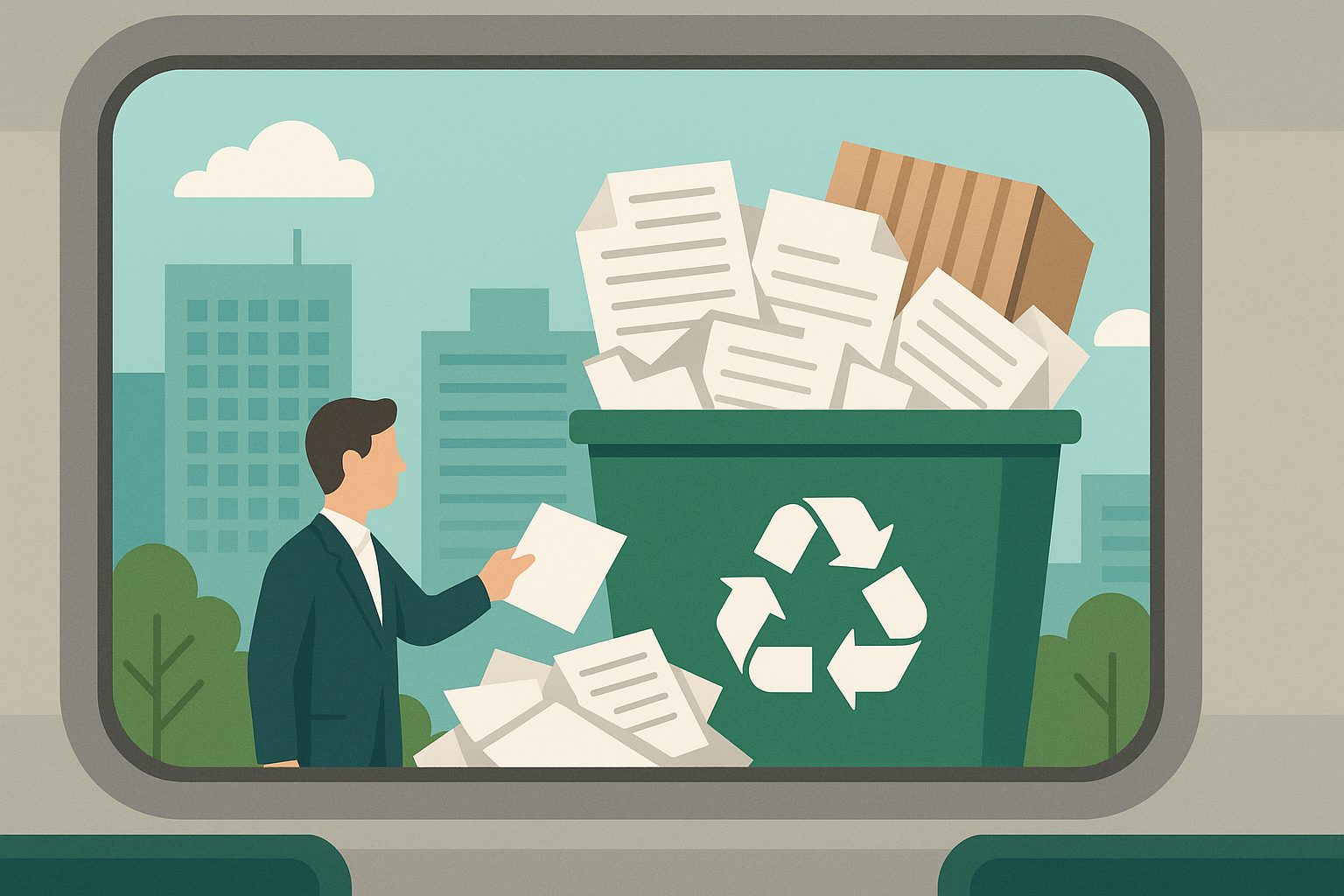
 Of all business waste, paper waste is one of the resources with the highest potential for recycling. High-quality office paper and cardboard are in demand as a resource for recovered paper. The paper recycling rate in Japan is highest among the countries in the world, with a collection rate of 81.6% (5th in the world) and a utilization rate of 66.8% (doubled in the 50 years since 1970). However, the reality is that there is still a significant amount of paper that is discarded without being recycled, especially the one discharged from the business sector. Here, we are going to take a deeper look into the value of paper waste as a resource and the specific actions that companies can take to maximize that value.
1. Potential of paper waste from business sector
Paper is a material whose raw material, fiber (pulp), can be reused. It is considered a “typical recycled material” along with metal and glass. In particular, general paper waste from offices and waste paper from the printing and publishing industry are highly valued as raw materials for recycled paper due to their long fibers and high whiteness. Domestic collection routes for cardboard are also well-established, and demand for recycled cardboard is always stable.
However, in reality, there are many cases where these “high-quality resources” are not fully utilized and end up being disposed of as mixed waste.
“It gets mixed up with paper cups and thermal paper.”
“It will not play if it gets dirty or wet.”
“Sorting rules are vague, leading to wasteful mixing.”
For those reasons, paper that could be recycled falls through the cracks. From the perspective of resource circulation, paper recycling is also highly effective. Using recovered paper reduces the use of virgin pulp, which not only helps preserve forest resources but also reduces the energy required for the manufacturing process. As a result, it also contributes to a significant reduction in CO₂ emissions. In other words, properly sorting paper waste is one of the most effective ways to reduce a company’s environmental impact “at low cost and immediately.”
2. Case study: cutting-edge approach by companies in the paper industry
When discussing the potential of paper recycling, the efforts of paper-related companies are of great help. In order to secure a stable supply of raw materials for their products, they are actively investing in the quality control of recovered paper and the development of new recycling technologies.
For example, Nippon Paper Industries Co., Ltd. has partnered with newspaper companies and other organizations to establish a “closed loop” system for recycling waste paper. Under this system, used newspaper at home and waste paper from printing plants are collected and used as raw material for recycled paper at its own paper mills. It also operates an initiative called “choito®,” which collects food and beverage containers made from paper, recycles them into paper yarn, and even upcycles them into textile products. This initiative began in 2019 to collect paper cups used at Nippon Paper’s headquarters office and recycle them as raw material for cardboard at the Ashikaga Mill.
Furthermore, Daio Paper Corporation has expanded the reuse of used magazine and other hard-to-process waste paper from printing and publishing by modifying and strengthening its manufacturing facilities. For example, it uses specialized equipment to automatically remove spine glue and film from magazines, which were previously difficult to process. Thanks to the technology, it is now available to reuse the waste paper not only for paperboard but also for general paper.
Oji Materia Co., Ltd. also uses a wide range of waste paper, including cardboard, magazines, and other documents, as raw materials for cardboard and white paperboard. Using a “kneading pulper” that specializes in dissolving difficult-to-recycle waste paper, the company is able to turn waste paper into recyclable material.
According to the case studies above, it is noted that the following aspects are observed in common:
- Focus on the “type” and “quality” of recycled paper
- Develop a system for sorting and collecting waste is in place, tracing it back to the source (printing, publishing, offices).
- Design its whole process from collection to recycling
3. Practical measures that companies can take
So, what can businesses and companies do to increase their paper waste recycling rates? Here are some relatively easy steps to take.
(1) Clarifying and enforcing sorting rules
First, it is important to indicate what can be recycled for each type of paper. It is effective to list the classifications with specific examples such as copy paper, slips, cardboard, newspapers/magazines, envelopes, etc. and post this in a common space.
In particular, thermal paper, oily paper, laminated paper, and other items that are likely to hinder recycling should be clearly distinguished as prohibited items.
(2) Optimal management methods according to the source
In the office, it is effective to understand the sources of paper generation and set up appropriate collection points. For example, small changes can greatly improve the quality of paper sorting, such as placing a dedicated paper recycling bin next to the copy machine, promoting the digitization of meeting materials, and storing shredded paper in a dry place. In the printing and publishing industries, separating waste paper by print type and paper quality is key. In the distribution industry, which uses a lot of cardboard, physical organization, such as folding cardboard before collection and clearly defining storage locations, increases recycling efficiency.
(3) Strengthening cooperation with collection companies
Paper quality is also an important factor for collection companies. If a company sorts its paper properly, it will be more likely to be collected as recyclable material. Therefore, it cann be said that communicating with collection companies and sharing sorting tips and improvement ideas become a great benefit to both parties.
4. Summary – Paper waste as a material to tackle most easily and effectively
Used paper is highly valuable as a raw material for recycled paper, whereas it is an important recyclable resource that supports Japan’s paper industry. Although much of the paper waste generated by businesses is recyclable, there are many cases where it is not recycled due to insufficient sorting or a lack of information. This situation can be greatly improved by companies simply changing their awareness and behavior a little.
The amount of paper waste each time may seem insignificant. However, how much does your office or business produce in a month? We hope you will start by visualizing the amount of paper waste you produce by sorting it.
If you are a business in Nishinomiya City, Hyogo Prefecture, and would like to collect waste paper, please contact SocialBridge Co., Ltd.

<List of references and sources>
- Nippon Paper Group “Environmental and Social Report”
- Newspaper recycling initiative (a closed-loop example between newspaper companies and collection companies)
(Reference: Case Studies from the Ministry of the Environment, Japan) - “choito®” project: upcycling used paper containers
Nippon Paper Industries Official Release/Japan Paper Association “Examples of Promoting Paper Recycling” - Daio Paper “Environmental and CSR Activities Report”
- Initiatives for hard-to-process waste paper (recycling facilities for magazine paper and back-glued paper, etc.)
- Oji Materia “Initiatives for Sustainability and Recycled Paper Use”
- Waste Paper Recycling Promotion Center, a Public Interest Incorporated Foundation – Waste Paper Recycling in Numbers